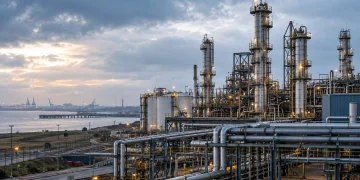
Iran’s parliament has voted to close the Strait of Hormuz, a move that could shake up the world’s oil supply. This decision, made on June 22, 2025, follows U.S. airstrikes on Iranian nuclear sites.
The strait is a narrow waterway between Iran and Oman. It’s a key route for oil and gas exports. With tensions rising, people worry about higher oil prices and energy shortages.

Why the Strait of Hormuz Matters
The Strait of Hormuz links the Persian Gulf to the Gulf of Oman. It’s a busy path for oil from countries like Saudi Arabia, the UAE, Kuwait, Iraq, and Qatar. About 20 million barrels of oil pass through it each day, says the U.S. Energy Information Administration (EIA). That’s roughly 20% of the world’s oil use. Closing it would be a big deal for energy markets everywhere.
What Happened in Iran
On June 22, 2025, Iran’s parliament said yes to blocking the strait, according to CNBC. They did this because of U.S. attacks on their nuclear sites. It’s a way to push back against the U.S. The vote doesn’t mean the strait is closed yet, but it’s a strong warning. Oil prices have already gone up a bit because of this news.
How This Could Hurt the Economy
If the strait shuts down, over 17 million barrels of oil per day could vanish from the market. Experts think oil prices might jump by 30-50%. Brent oil could hit $110 per barrel, says S&P Global. In the U.S., gas prices might rise from $3.14 to $3.50 per gallon, reports Newsweek.
Asia would feel a lot of pain too. Countries like China, Japan, and India get most of their oil and gas through the strait. Qatar sends 20% of the world’s LNG through it, per CNBC. A closure could mean higher energy costs and slower economies in these places.
Tensions Around the World
This vote has made things tense globally. The U.S. asked China to step in and stop Iran, says BBC News. Analysts from Eurasia Group, quoted in Axios, think a full closure won’t happen. The U.S. has warships nearby, and a total shutdown could start a war. Iran might try smaller disruptions instead, like using boats or mines to mess with ships.
Will the Strait Really Close?
Many experts say a long closure isn’t likely. Iran needs the strait for its own oil exports too. Blocking it could cost them $123.8 million a day, notes an X post by @voodoodreams. Plus, the U.S. Navy could stop it fast. Iran has missiles and mines, but they’d only slow things down for a short time, says an X post by @drraju2.
How Markets Are Reacting
Oil prices are already climbing. Brent crude is at $78.95, and WTI is at $75.75, per S&P Global. If the strait closed even partly, prices could spike to $110. Markets are nervous, and stocks and crypto prices dropped, says an X post by @zGuz.
Backup Plans
There are other ways to move oil, but they’re not enough. Saudi Arabia has a pipeline that can carry 7 million barrels a day. The UAE has one for 1.8 million. Together, they can’t replace the 20 million barrels from the strait, per the EIA. Iran’s own pipeline isn’t working well either. Shipping costs would go up, and delays would hit hard.
What Could Happen Next
If the strait stays closed for a while, oil prices could stay high. India, which gets 2 million barrels a day through the strait, might see prices hit $80, says The Times of India. Europe and the U.S. would struggle to find oil too, per S&P Global.
Iran’s vote to close the Strait of Hormuz has everyone on edge. It’s unlikely they’ll follow through for long because it would hurt them too. The U.S. and others will push back hard. Still, even a short disruption could raise oil prices and shake up energy supplies.